
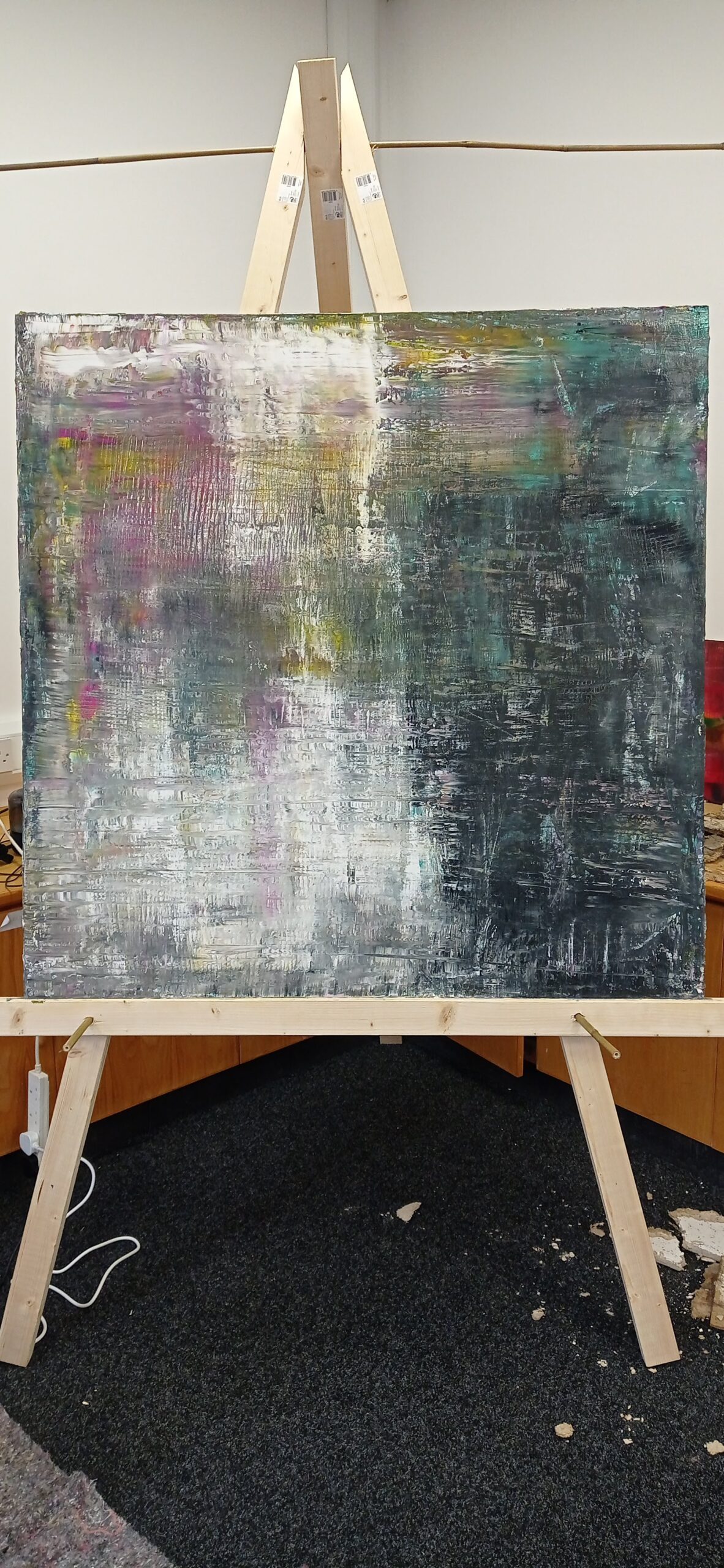
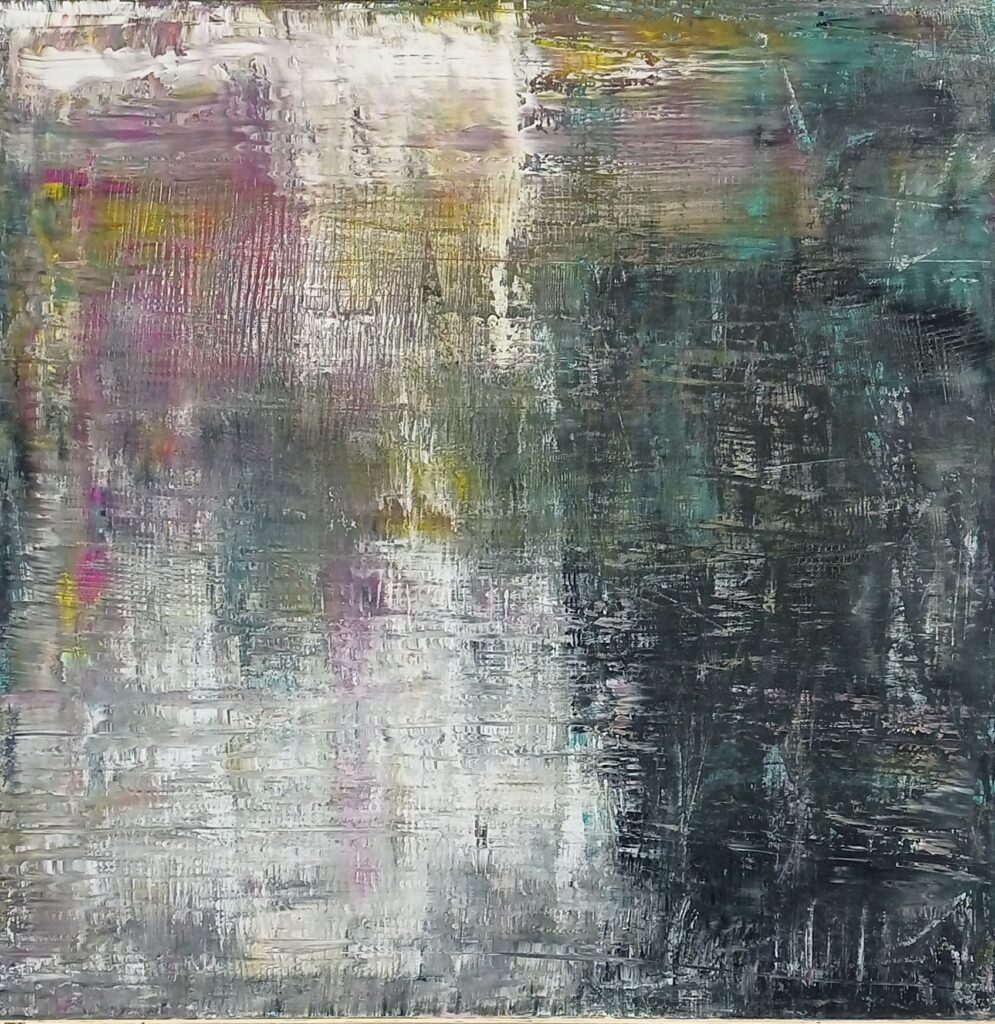
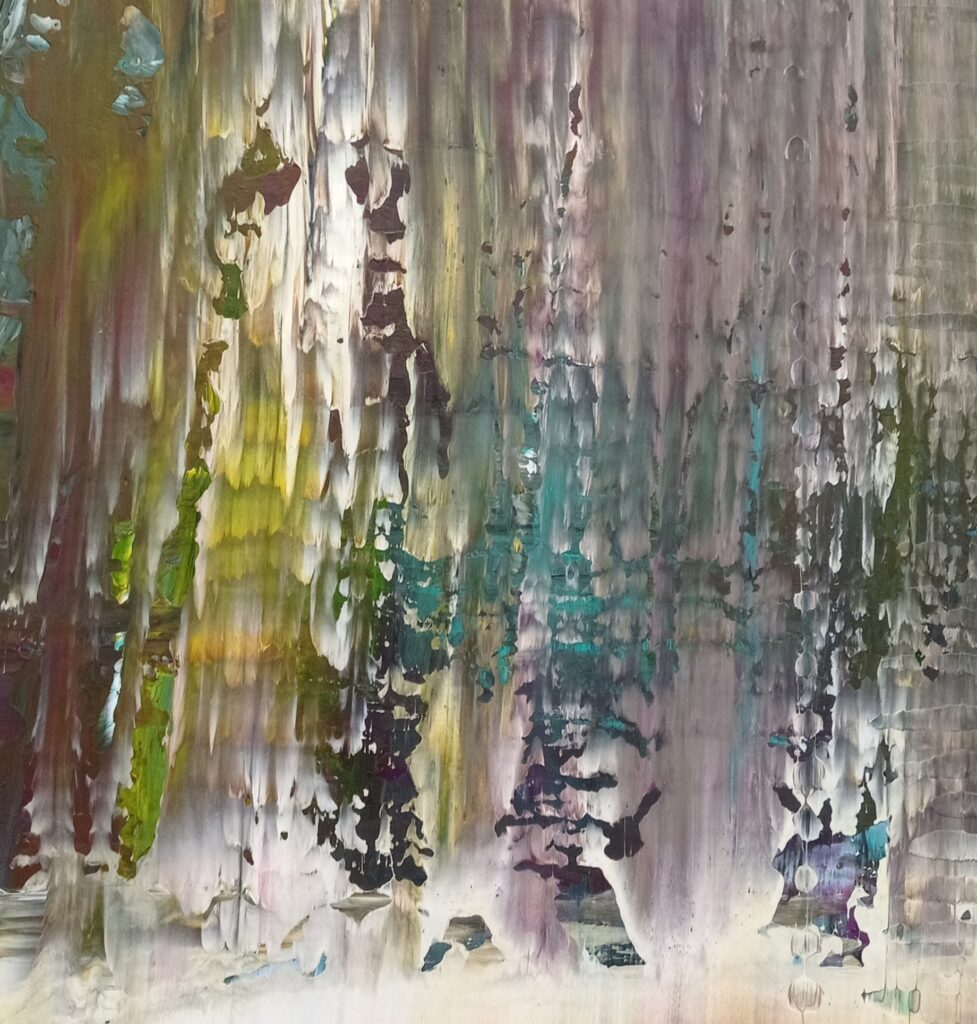
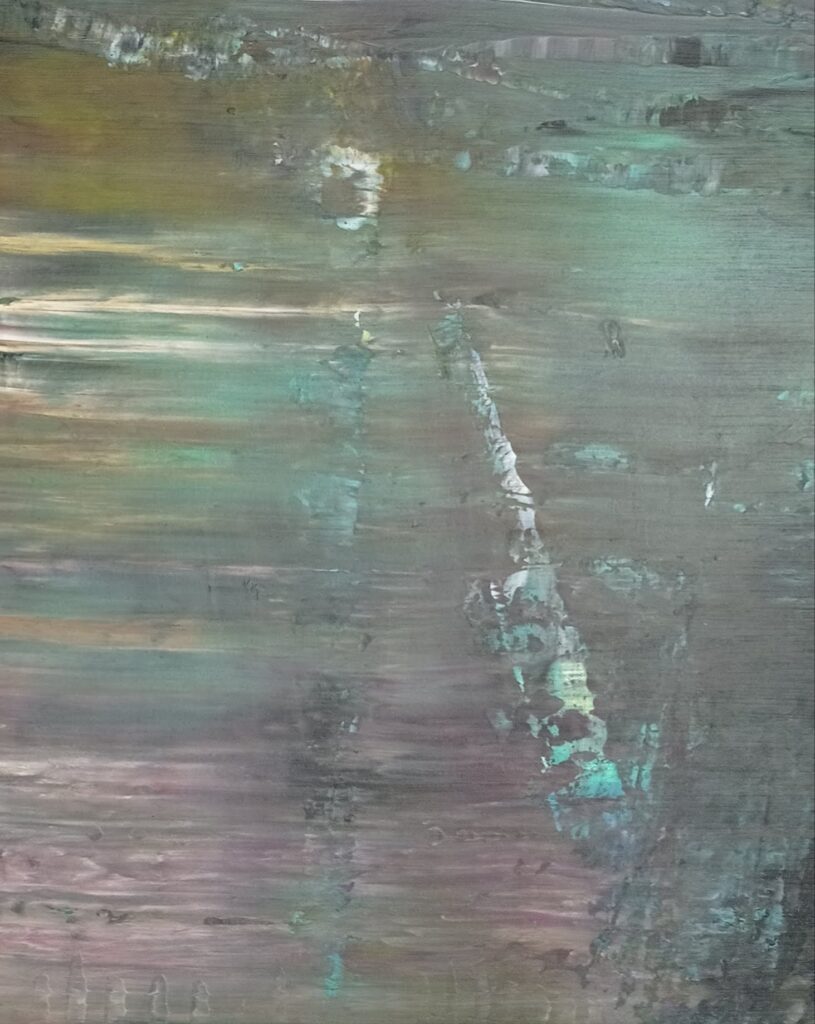
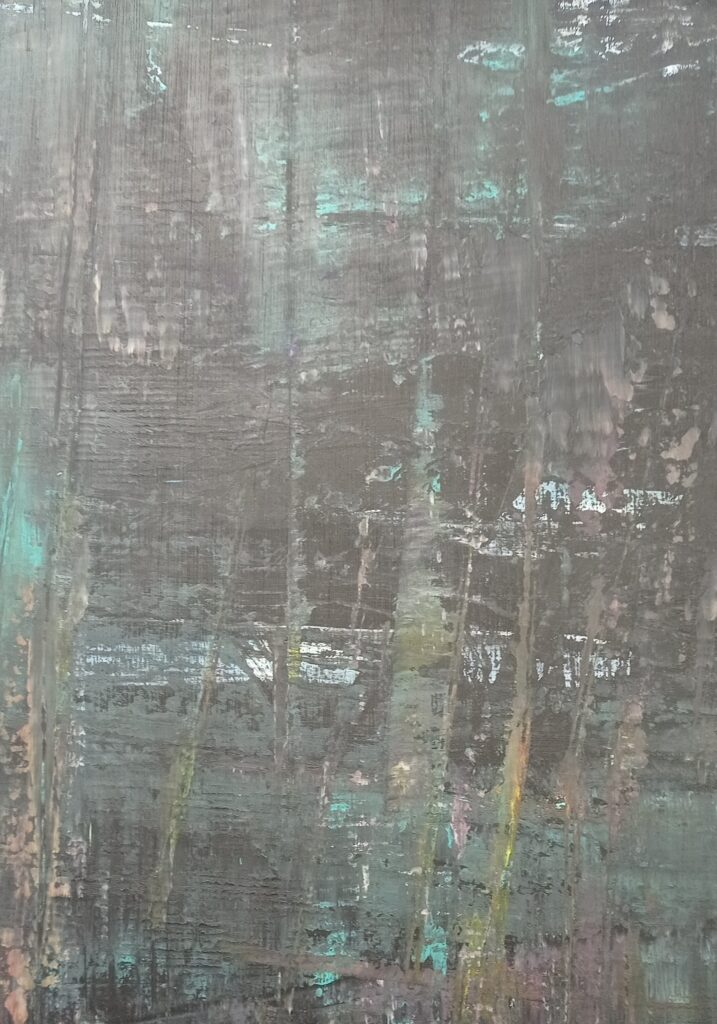
“Phase Transitions”, acrylic on plywood 1.2×1.2×0.05 m Horus9X! copyright
with its sharp contrast between a dark, high-friction mass on the right and a pale, fluid, highly textured turbulence on the left— visualizes a material system undergoing a rapid temperature quench, showing the formation of structural defects along a phase boundaries. [1, 2]
System Architecture Diagram Mapping
The vertical scrapes and color boundaries map onto the emergence of order out of chaotic thermal fluctuations:
      HIGH-TEMPERATURE LIQUID           CRITICAL INTERFACE          QUENCHED TOPOLOGICAL DEFECTS
    +--------------------------+    +------------------------+    +-------------------------------+


    |  Zone 1: Left Light Band |    |  Zone 2: Shifting Mid  |    |  Zone 3: Right Dark Domain    |
    |                          |===>|  Symmetry Threshold    |===>|                               |
    |  High thermal energy;    |    |  (The Kibble-Zurek     |    |  Frozen lattice structure;    |
    |  unstructured state.     |    |   boundary zone)       |    |  trapped vortex lines.        |
    |                          |    |                        |    |                               |
    +--------------------------+    +------------------------+    +-------------------------------+
                 ||                                                              ||
                 +===============================================================+
                               Nonequilibrium Phase Coexistence
Breakdown of the Technical Gist
- The Disordered Left Zone (High-Temperature Fluid Phase): The left third of painting is dominated by high-contrast whites, faint magentas, and yellows. In thermodynamic simulations, this bright, unstructured density maps to the symmetric, high-energy phase of a material before it cools down, where atoms move too fast to lock into a rigid pattern.
- The Vertically Scraped Mid-Section (The Kibble-Zurek Domain Wall): The fine, repeating vertical comb marks running through the center simulate a phase transition boundary. According to the Kibble-Zurek mechanism, when a system cools too quickly, different regions choose their structural alignment independently. This texturing visualizes the exact boundary lines where those mismatched regions collide.
- The Dark Right Domain (Quenched Solid Lattice & Defects): The right half of your canvas drops into a dense, heavily layered black and deep teal grid. This represents the ordered low-temperature phase. The horizontal scrapes cutting through the dark paint mimic trapped topological defects—structural imperfections frozen into place because the material cooled too fast to heal its own lattice. [1, 2, 3, 4]
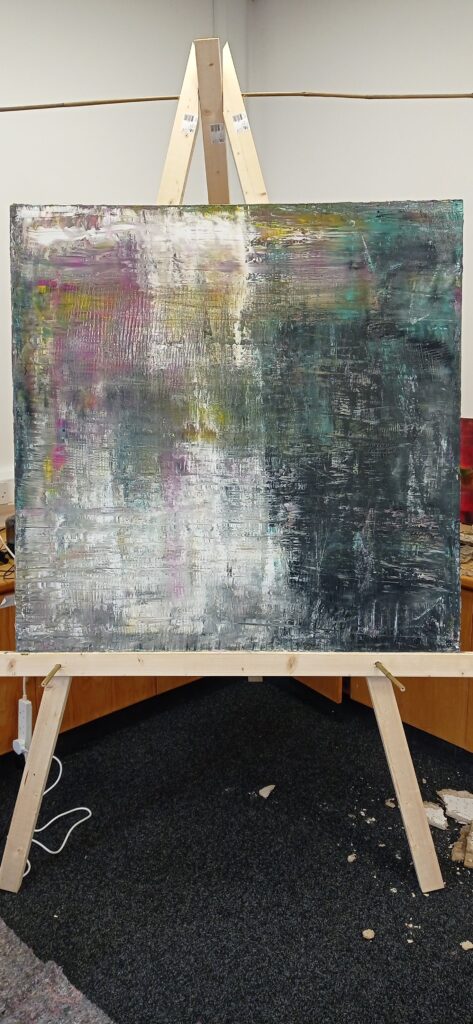
Python Mathematical Generation Script
This script uses NumPy and Matplotlib to simulate a 2D order-parameter field during a rapid thermal quench, generating the visual balance of painting.
python
import numpy as np
import matplotlib.pyplot as plt

# 1. Define Spatial Grid
N = 200
x = np.linspace(-2, 2, N)
y = np.linspace(-2, 2, N)
X, Y = np.meshgrid(x, y)

# 2. Zone 1: High-Temperature Disordered Fluid (Left Side Flare)
# Modeled using high-frequency noise and thermal fluctuations
thermal_noise = np.random.normal(0, 0.4, (N, N))
left_fluid = np.exp(-(X + 1.5)**2) * 1.2

# 3. Zone 2: Kibble-Zurek Interface (Vertical Striations)
# Fine vertical comb lines mimicking the scraped texture in the center
striations = np.sin(35 * X) * np.exp(-X**2 / 0.5) * 0.3

# 4. Zone 3: Quenched Dark Domain with Defect Lines (Right Side)
# Represents the dense, lower-energy structural matrix
right_domain = (1 / (1 + np.exp(-3 * X))) * 1.5
# Introduce discrete line cracks/defects into the right matrix
defects = np.sin(3 * Y) * np.cos(15 * X) * (X > 0.2) * 0.4
quenched_solid = right_domain - defects

# 5. Composite the Total Phase Field Matrix
phase_field = left_fluid + striations + quenched_solid + (thermal_noise * 0.15)

# 6. Plotting with a Customized Color Palette Matching Your Artwork
plt.figure(figsize=(9, 8))
plt.imshow(
    phase_field,
    extent=[-2, 2, -2, 2],
    origin='lower',
    cmap='cubehelix',  # Recreates the bone-whites, deep teals, and dark charcoal tones
    interpolation='bicubic'
)

plt.title("Nonequilibrium Phase Transition Matrix Simulation", fontsize=12, pad=15)
plt.xlabel("Spatial Axis X (Domain Growth)")
plt.ylabel("Spatial Axis Y (Defect Propagation)")
plt.colorbar(label="Order Parameter Intensity $\\phi(x,y)$")
plt.grid(False)

plt.tight_layout()
plt.show()
Use code with caution.
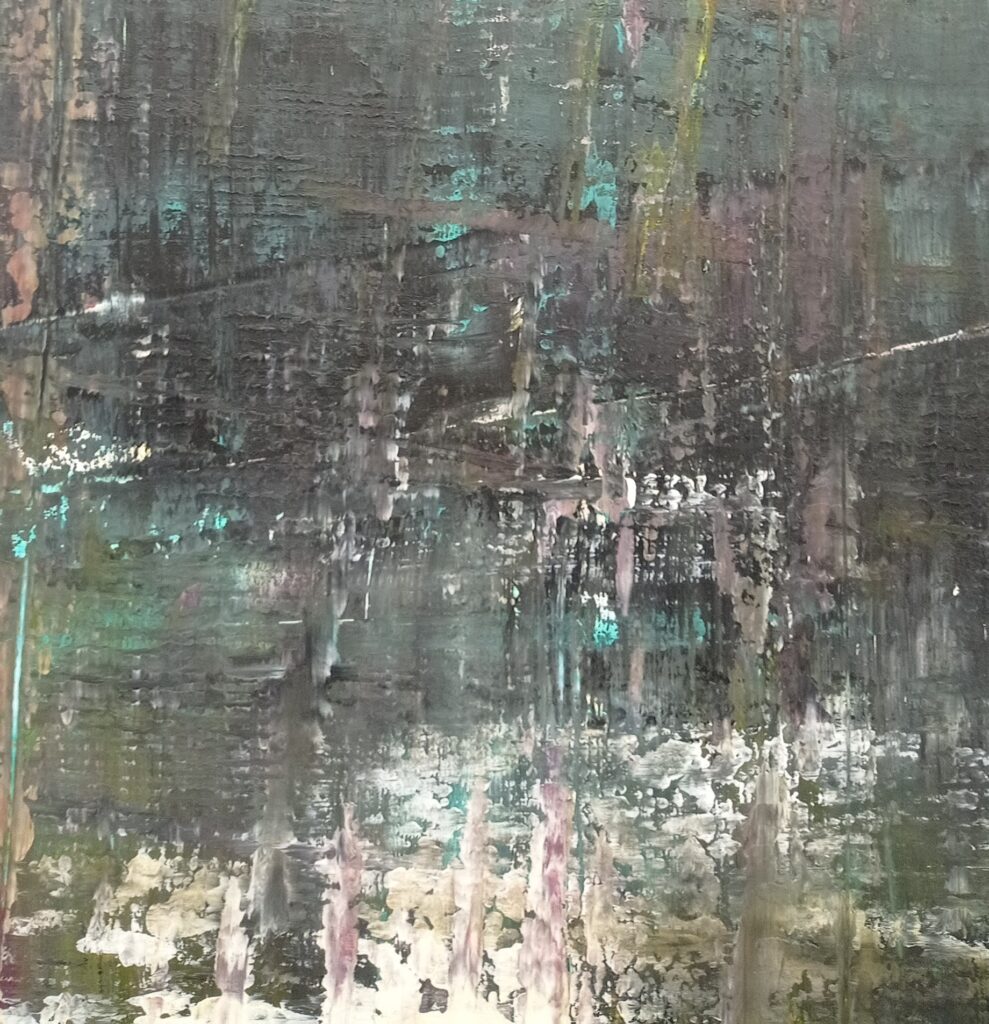
stable assistant take on it