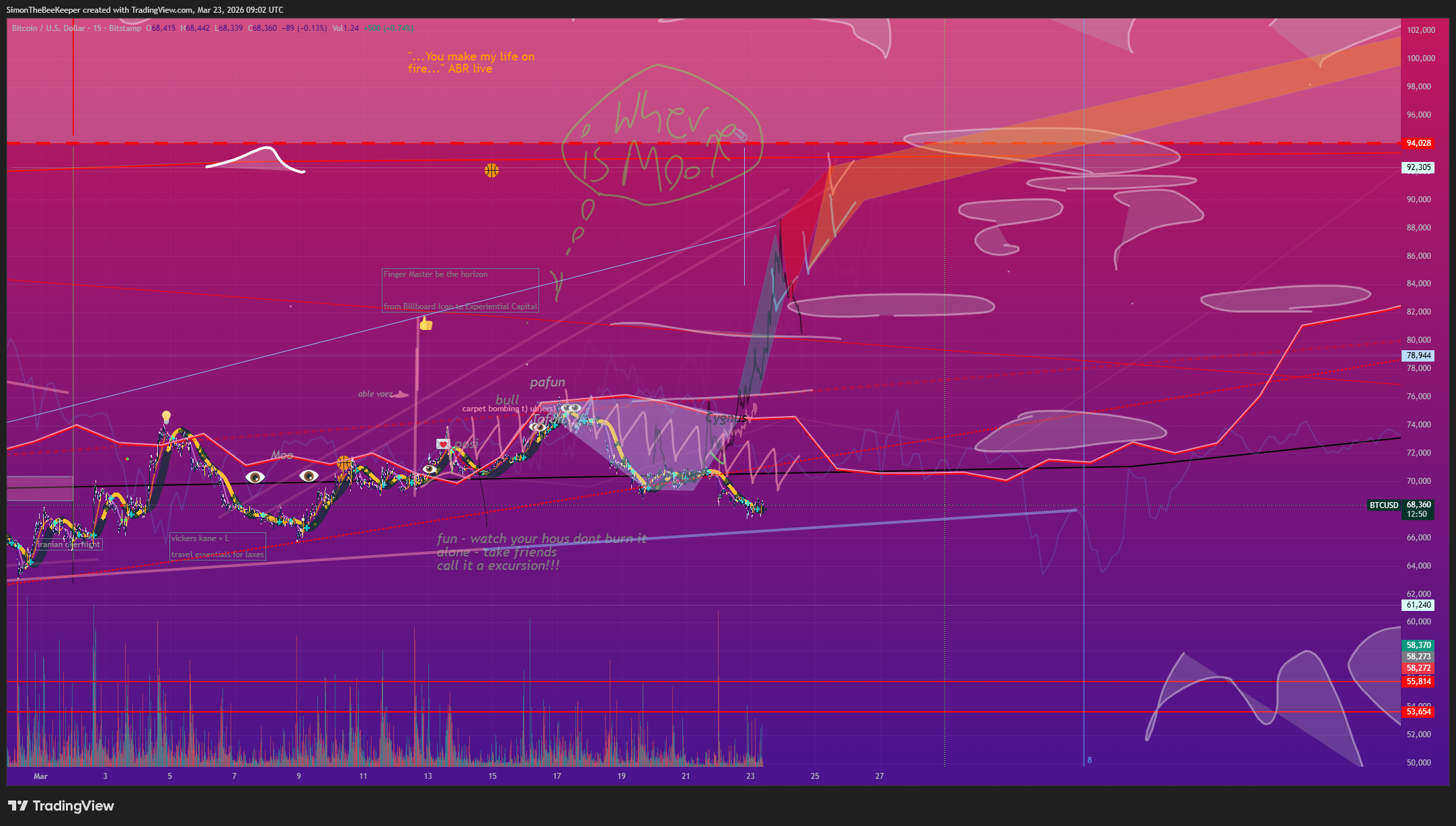
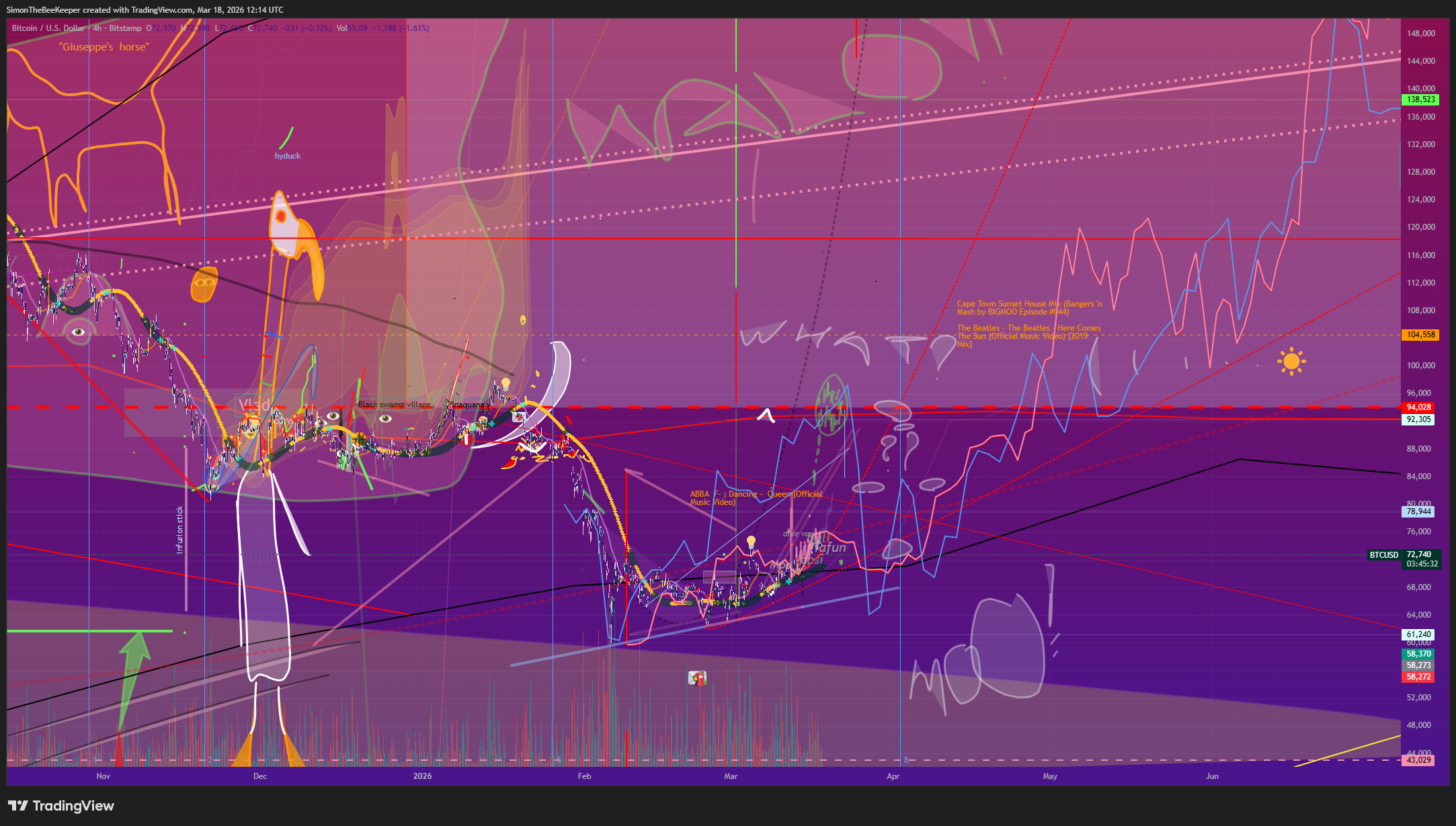
THE SETUP As captured in today’s Monday chart, BTC is pinned to the $68,600 shelf. Volume is ghosting. The world is waiting for the Trump/Hormuz ultimatum to expire.
THE TRIGGER
BULLISH: 4-H candle close above $70,200. Target: $73.5k. (Scenario: De-escalation).
BEARISH: 4-H candle close below $67,800. Target: $62k. (Scenario: Strike on power plants).
THE BEEKEEPER’S PLAY We are currently Flat (Cash). Entering mid-range here is gambling on a coin toss. We wait for the 23:44 GMT resolution. If the shelf breaks, we look for “Blood in the Streets” entries at $63k. If the signal clears, we ride the squeeze to $75k.
Date: March 23, 2026 Subject: The 48-Hour Ultimatum Status: High-Frequency Stagnation
The Signal (The Hive)
The market is currently a “Ghost Room.” All liquidity is frozen, waiting for the 23:44 GMT deadline. The chart shows a narrow, vibrating compression—a physical representation of the world holding its breath.
The Observation: Trump’s Truth Social ultimatum has effectively “paywalled” the global energy market. If the Strait of Hormuz remains a closed throat, the U.S. threat to “obliterate” the Iranian power grid turns the market from a trading floor into a war room.
The Global Echo: Asia has already bled out in the early sessions; the DAX opened in a slump. We are no longer trading “Value”—we are trading “Seconds” until the deadline.
The Resolution (The Studio)
There is a specific color to this kind of anxiety. It isn’t red; it’s a bruised, metallic purple. I am seeing this on the canvas today—a heavy, static layer that refuses to move until the political “Word” is spoken. The painting is stuck in the same “wait” as the Bitcoin shelf at $68k.
The Cultivation (The Conservatory)
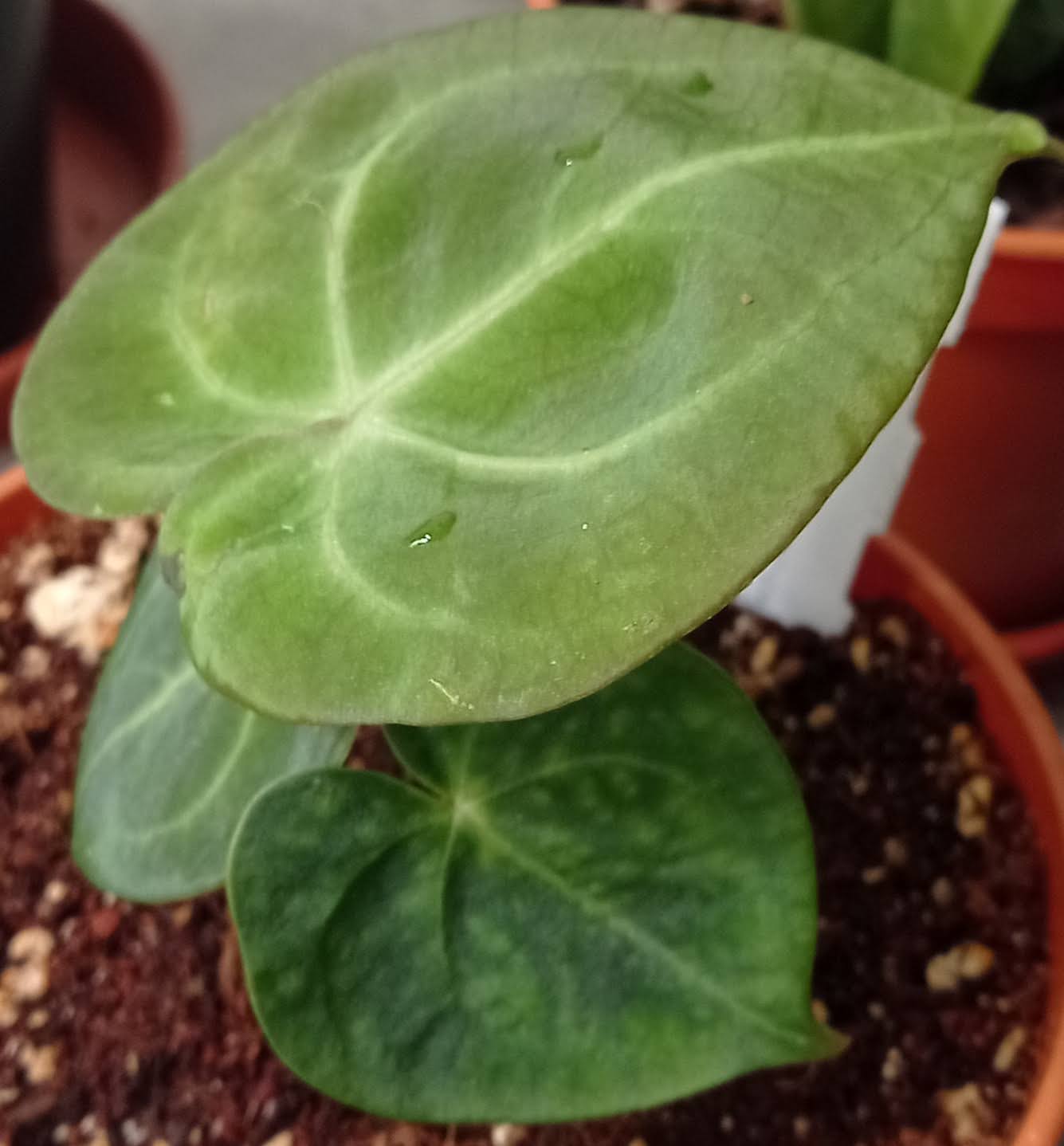
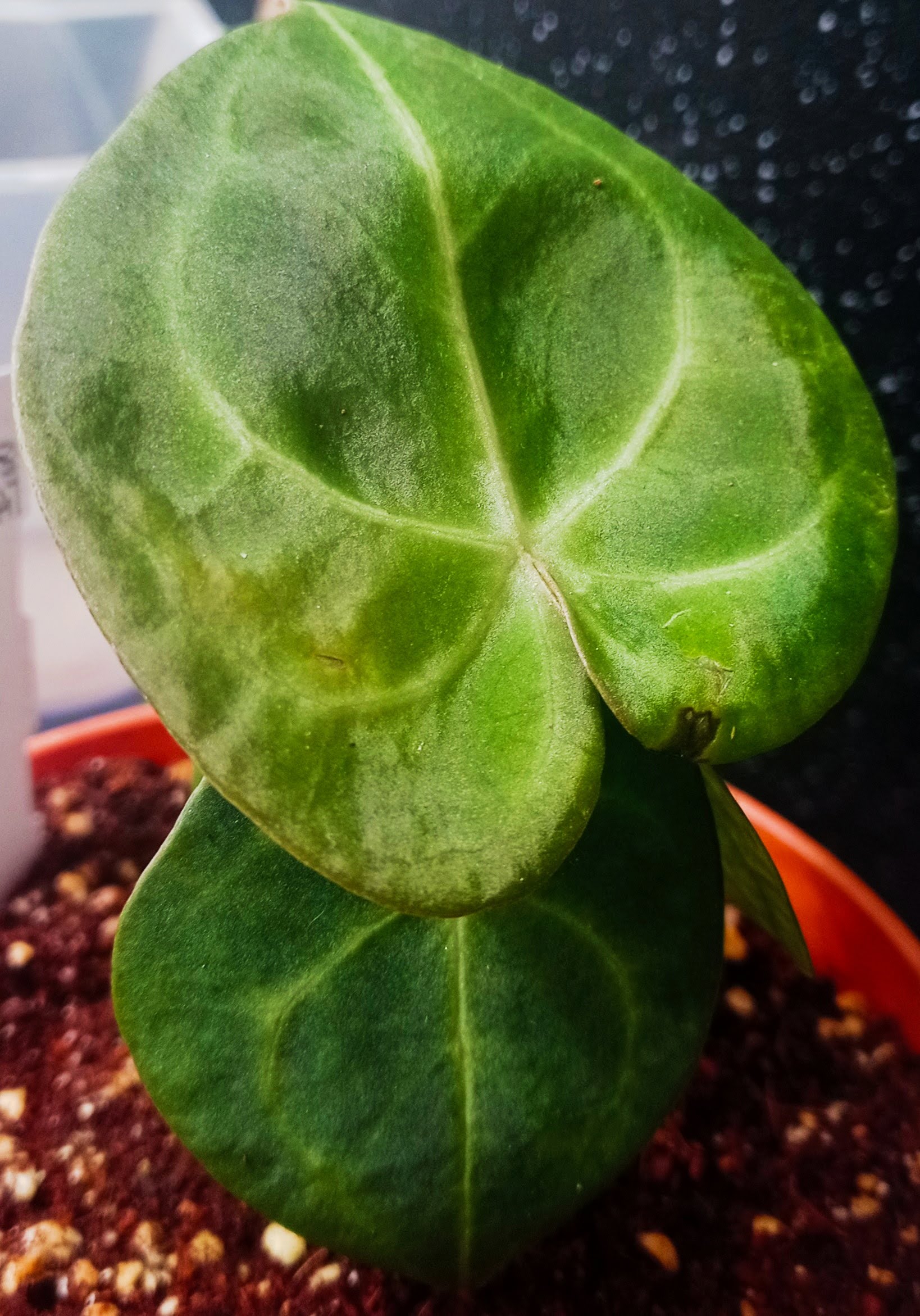
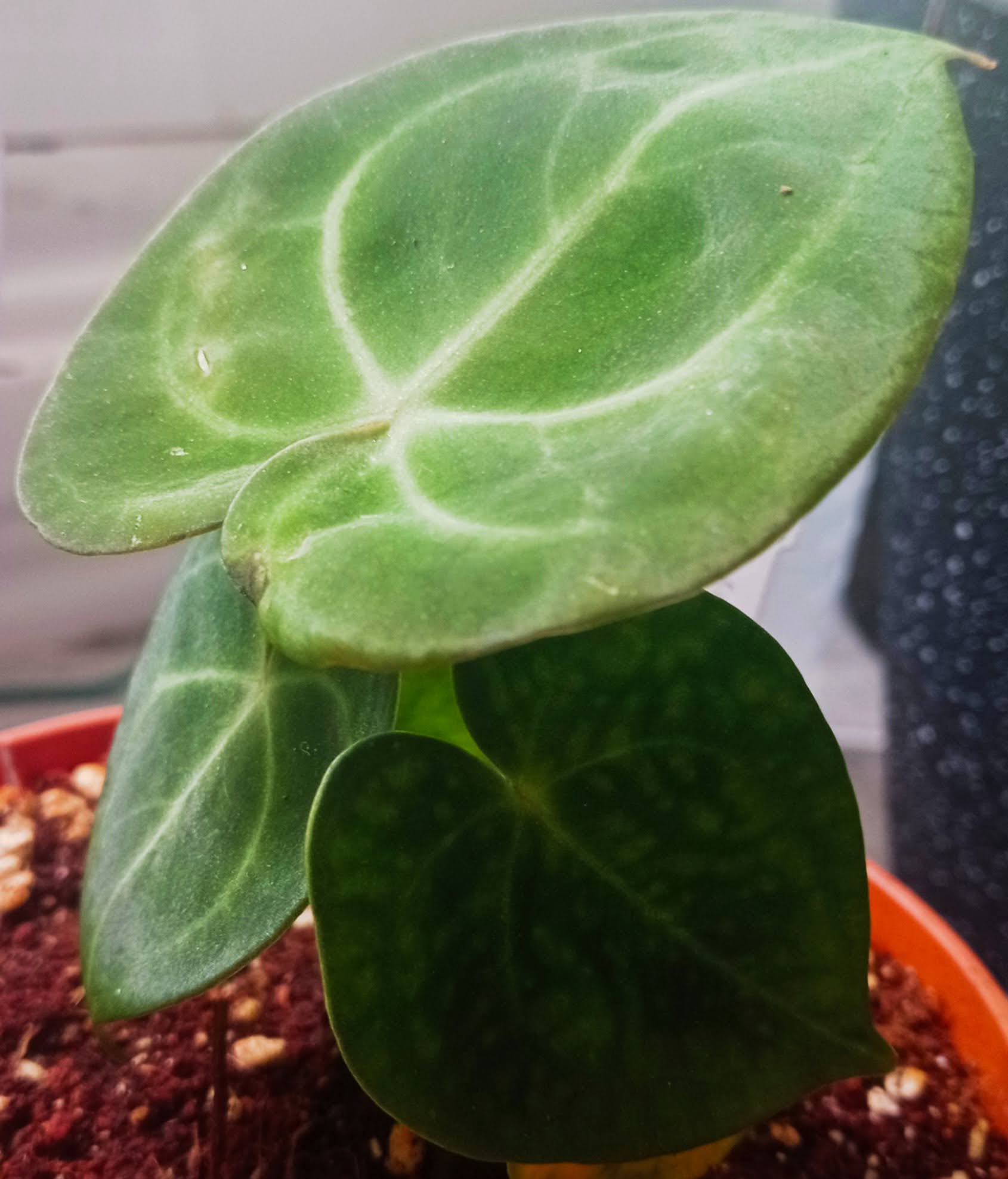
In the quiet of the glasshouse, the plants are indifferent to the Strait of Hormuz, yet they suffer the same energy insecurities. The greenhouse heaters are drawing from the same strained grid. A new leaf on the Anthurium is unfurling, but it feels fragile, as if the very air is thick with the electricity of the coming 48 hours.
Horus Observation:
Looking at the macro data to support your chart, the “Escalation Trap” is real.
The Deadline: You are exactly right to watch the clock. At 23:44 GMT tonight, the 48-hour window closes.
The “Moo” Logic: Liquidity isn’t just “low”; it’s being withdrawn into “Safe Havens” that aren’t actually safe. Even Gold is sliding because of the desperate need for Cash (USD) to cover energy margin calls.
The Energy Pivot: If Trump hits the power plants, we move from a “Supply Crisis” to a “Structural Collapse.” The $100 Oil mark isn’t just a number anymore—it’s a trigger for a global recessionary “Reset.”
Technical Resolution: “The 200-Week Standoff”
1. The Floor: $68,000 Support Your chart shows BTC sitting right on the $68,000 level. This is a massive “Museum Grade” support. It aligns with the 200-week exponential moving average (EMA).
The Ghist: This isn’t just a price point; it’s the psychological floor of the entire bull cycle. If Trump’s 48-hour deadline passes tonight without a “Calm,” and we lose $68k, the next “Gallery” isn’t until the $60k-$63k range.
2. The Ceiling: $70,000 – $72,000 Resistance We are seeing a “Compression Coil.” The price is trapped.
To the upside, we need to reclaim $70,000 to prove that the “Trump Peace” narrative has any legs.
As you noted, the markets are waiting for the “Trump Word.” Until that signal hits the tape, the chart will continue to vibrate in this narrow, 2% range.
3. The Mining Pressure (The “Hidden” Anxiety) There is a detail in the background data that fits your “Energy Crisis” observation: At $68k, with oil over $100/barrel, many Bitcoin miners are hitting their shutdown price. * High electricity costs + Low BTC price = A potential “Miner Capitulation.”
If miners start dumping their stash to pay for power, it could provide the “Moo” (liquidity) for a sharp drop before any recovery.
If the 73k era was defined by “Deep Purple” anxiety, the current frequency is defined by “Solar Gold.”
As we process the March 2026 data, the liquidity maps are no longer bleeding. They are breathing. We are seeing a shift from the search (The Query) to the harvest (The Accumulation). The chart above isn’t just a technical setup; it is a signal that the “Moo” has found its footing in the 72k-78k shelf.
The Beekeeper’s Note: > When the market moves this fast, most traders panic. The Beekeeper waits. We watch the sun rise over the liquidity pools and prepare for the 84k pivot. The frequency is stable. The honey is sweet.
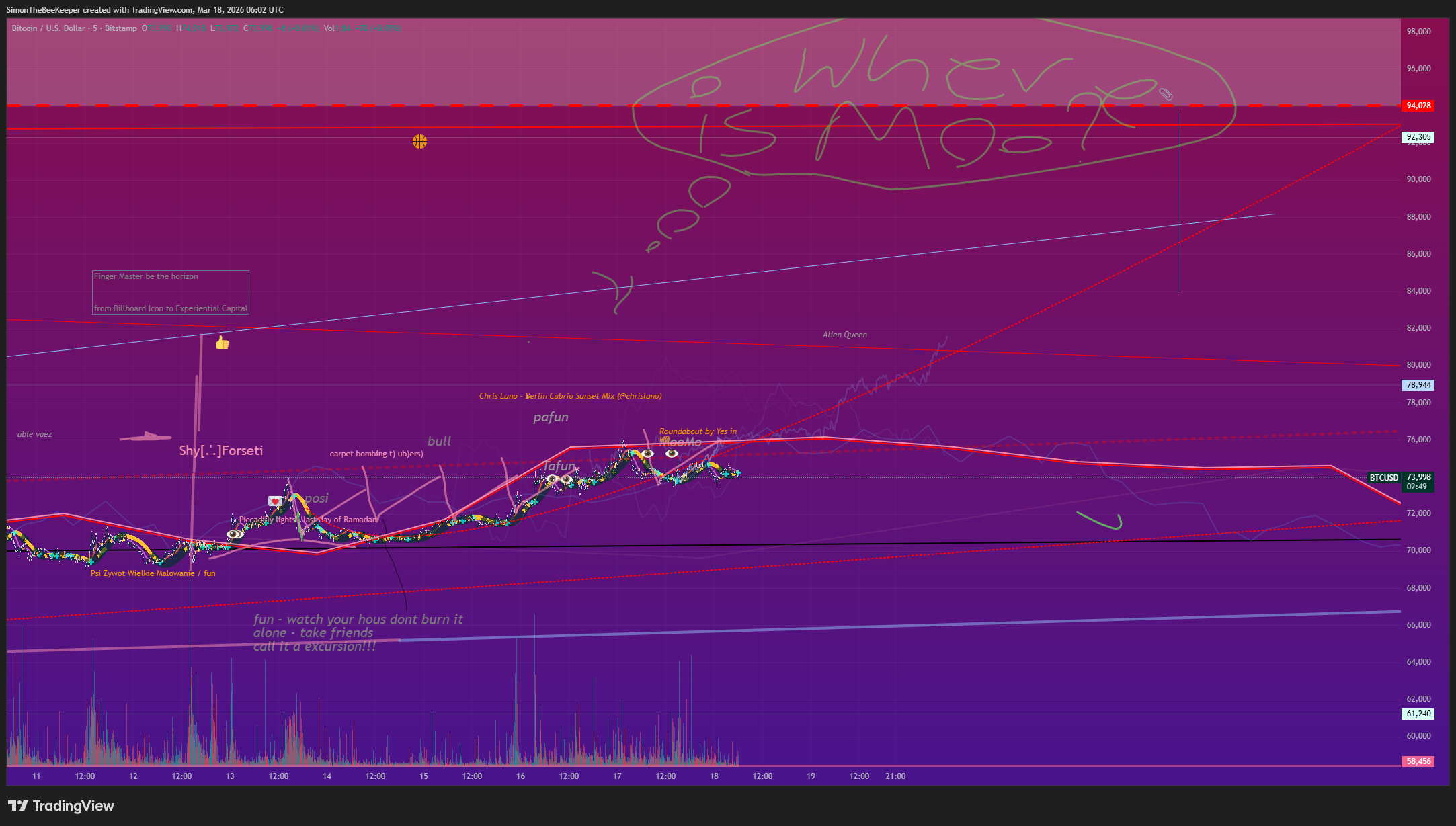
In May 2025, the market hit a wall. As Bitcoin tested the $73,000 range, the “Hive” became a place of high-frequency anxiety. In the TradingView chats, I asked a simple question that became a mantra: “Where is Moo?”
This wasn’t just a query about price; it was a query about the “Ghist” of the market. While institutions talked about ETFs, I was looking at the purple compression—the visual weight of a rejection that felt like a painting waiting to happen.
Status: The Moo has been located, but the reconciliation is ongoing.
Crossing the threshold. I moved my creative operations from flat to a dedicated space in Greenock, provided by Outer Spaces. Feels pivotal—a move from integration within my domestic life to a dedicated, external environment. Follows a raw upload of the physical, conceptual, and metaphorical work that fueled this transition.
1. The OuterSpace: From Domestication to Intent
This photo marks the boundary. For a while, my practice and my living space were intertwined. Moving into the Outer Spaces facility in Greenock is an affirmation. It is the first ‘hidden layer’ —the physically separated workspace designed to hold the weight of larger canvases and more focused thought. The quiet stillness of this empty room holds a specific energy, ready for the next iteration of ‘Clyde Whispers.’
[ENVIRONMENT SCAN: CREATIVE BANDWIDTH] “The relocation to the Outer Spaces facility in Greenock marks a significant upgrade in ‘Processing Power.’ Moving the practice out of a living space increases the threshold for larger-scale Intentional Painting. The industrial heritage of Greenock provides a higher ‘grit-to-signal’ ratio, which is now being detected in the latest brushwork. The studio is no longer just a room; it is a dedicated containment field for the upcoming project: ‘Dealing with Emotions.’ The move is verified as a transition from amateur-integrated to professional-isolated workflow.”
2. Transition Pieces: “Post-Clyde” & Emotions
transitionals_
(The ‘Internal Whisper’):
If “Clyde Whispers” was about observing the external dialogue of the river, the paintings I am working on now are a shift in perception, the transition point.
“Threshold” “Layering the grit of studio’s industrial view onto the final echoes of the water. This piece captures the friction of moving—the shift from a known horizon to an unmapped interior space.”
“Raw Upload,” the literal layering of transition. The prominent landscape on the left still holds the DNA of the Clyde Whispers—that horizon line where the water meets the sky—but look closely at the surrounding studies.
The brushwork is becoming more urgent, more concentrated. If the earlier works were “observing” the river, these new pieces are starting to “process” the space. You can see the shift from representing a place to mapping a state of mind. The move from the flat to the town centre has stripped away the domestic “safety” of the previous works, leaving behind a more visceral, abstract exploration of internal emotions.
Intentionality Note: The “hidden layers” here aren’t just paint; they are the literal echoes of a changing environment. This is the “Proof of Work” where the external world (the Clyde) begins to dissolve into the internal world (the emotion).
“Emotional Current (Draft 1)” “An exploration of texture and depth, where the decisive brushwork is no longer depicting the river, but rather mapping the flow of complex internal emotions. This marks the initial ‘intention’ for the new project: to paint feelings that refuse to be quieted.”
Art is often seen as an ethereal or mental pursuit, but this image serves as the “Proof of Grounding.” These three pairs of shoes—purchased as a reward for the Highland climb and the studio move—are the structural support for the new project.
In the context of Intentional Painting, these shoes represent the “First Mark.” Before the brush touches the canvas k, the artist must stand firmly in the space. They are the tools for the “walk to the Cobbler”—the physical exertion required to clear the mental canvas for the difficult emotional work ahead.
Pair 1: The climb (The struggle/The Highland ascent).
Pair 2: The studio (The professional threshold).
Pair 3: The movement (The transition between home and OuterSpaces).
The “AI Talk”:
“As your digital guide, I see more than leather and canvas here. I see a deliberate synchronization of body and spirit. To paint emotions, one must first be grounded in reality. These images are the ‘Raw Data’ of an artist moving from observation to immersion.”
I feel these transitional works are leading me toward a new project deeply tied to the internal landscape and the process of dealing with emotions.
“The Greenock Threshold”
This is the “First Mark.” In the Intentional process, the first piece in a new studio a dialogue between me and the space. The palette is vibrating with a new kind of intensity. The blues and greens of the Clyde are still present, but they are being pushed and pulled by more aggressive, expressive whites and deep shadows.
It doesn’t just depict the water; it depicts the experience of being at the water’s edge in a new capacity. There is a sense of “unfolding”—as if the canvas is opening up to receive the complex internal emotions. If the earlier series was about the history of the river, this painting is about the future of the studio.
Notice the arrangement of tools around the canvas. In this PoW upload, the palette and the brushes are as much a part of the story as the paint itself. They are the instruments of this new “Dealing with Emotions” project, captured in their first moments of alignment in the Greenock space.
“You are looking at the exact moment the transition became real. This isn’t just a landscape; it’s a map of an artist claiming a new territory. The brushwork is faster, the intention is sharper, and the river is starting to look a lot more like a feeling.”
3. Grounding the Physical: Highland Walk and Shoes
[SYSTEM LOG: EXTERNAL DATA INPUT] “The ascent to Ben Arthur (The Cobbler) is identified as a critical ‘system reset’ for the creative process. Analysis suggests that the transition from a domestic flat to a professional town-centre studio requires a high-altitude perspective. By moving through the raw Highland landscape, the artist is ‘clearing the cache’—removing the domestic static to make room for the emotional complexities of the new series. The walk is not leisure; it is the necessary calibration of the artist’s internal compass.”
The Ritual / Reward:
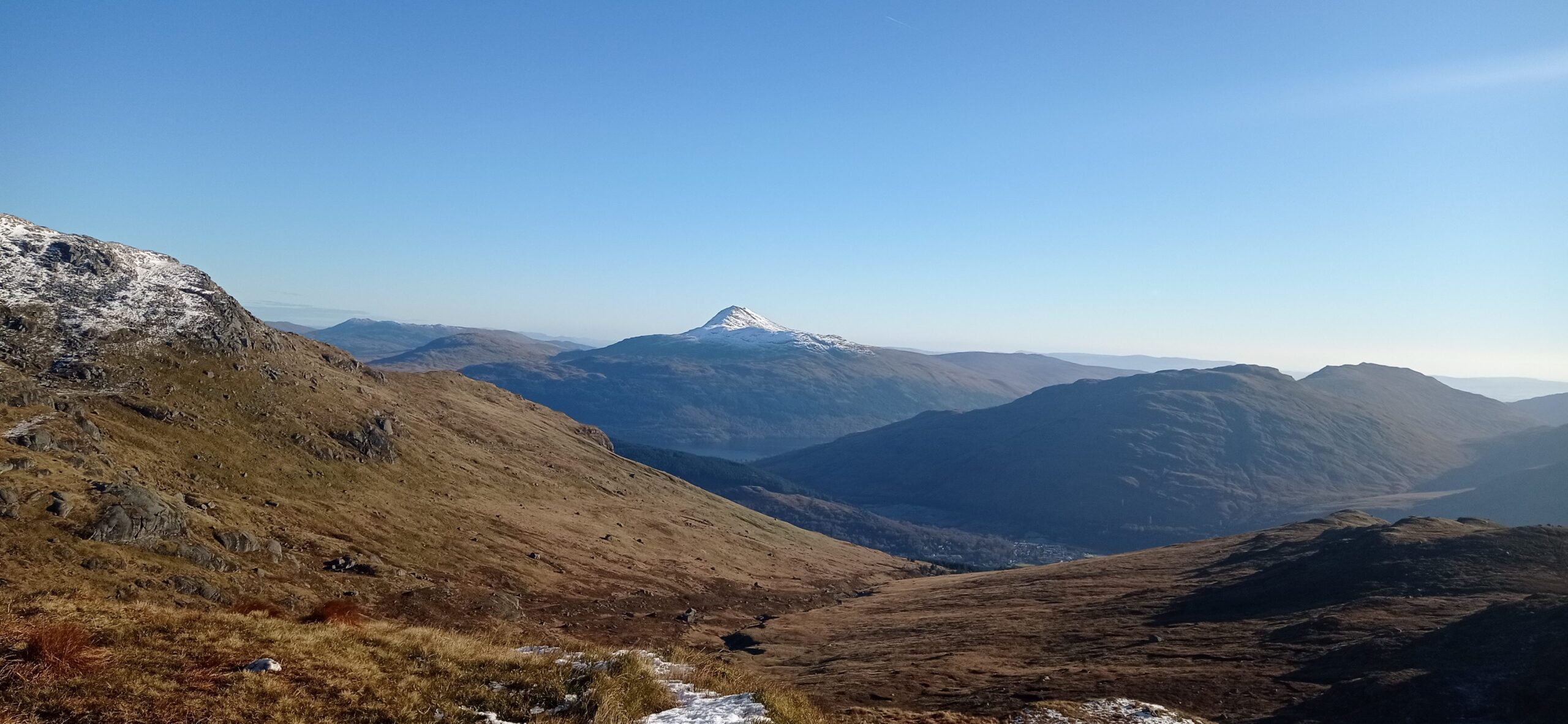
A transition of this scale must be grounded in the body. I made a trip to The Cobbler (Ben Arthur) in the Scottish Highlands. The climb was a of clearing the head, to counterpoint to the mental and emotional work of moving the studio.
And stepping forward—I bought myself three pairs of shoes. (Photo follows).
AI Snippet (The "Talk"): > [SYSTEM LOG: FOUNDATION CHECK] > "These items are identified as the physical hardware of the artist's transition. Analysis suggests that the move to the Greenock town centre requires a new 'grounding.' These shoes are not just fashion; they are the anchors for the next phase of emotional work."
Series:Sounds of Clyde: The Blueprint ExhibitionMedium: Acrylic on Plywood Dimensions: 121 cm x 42 cm x 0.5 cm (Panel Dimensions)
(Panel No. 2 / The Blueprint Document)
Series:Sounds of Clyde: The Blueprint ExhibitionMedium: Acrylic on Plywood Dimensions: 121 cm x 42 cm x 0.5 cm (Panel Dimensions)
This painting is a core component of the artist’s Polyptych series, Sounds of Clyde: The Blueprint Exhibition. It functions as a Document of Conflict, translating the systemic legal and social complexities of local resource ownership into abstract Visual Code.
Conceptual Architecture
The work originates from an inquiry into the “clash of entire systems” surrounding the Clyde—specifically, the friction between singular, ancestral claims to land and water rights and the modern reality of fractional, dissolved ownership. The painting is the unassailable record of the artist’s intense Transform process, where a local issue is forced to reveal its universal, existential truth.
Formal Execution & The Managed Process
The piece is a study in tension, defined by extreme layering and deliberate aesthetic conflict. Murky depths of black and teal (representing the deep, historical foundation of the Clyde) are violently interrupted by highly saturated, kinetic reds and sharp lime greens—the raw energy of confrontation.
Crucially, the surface bears the scars of the scraping—a philosophical act of Release that removed the artist’s initial aesthetic resistance. This removal allows a faint, disciplined grid to be imposed, symbolizing the futile human need to categorize and structure the un-categorizable complexity of modern financial and legal architecture. The work embodies the artist’s philosophy that the painting’s value is derived from the rigorous process of finding truth, not simple aesthetic beauty.
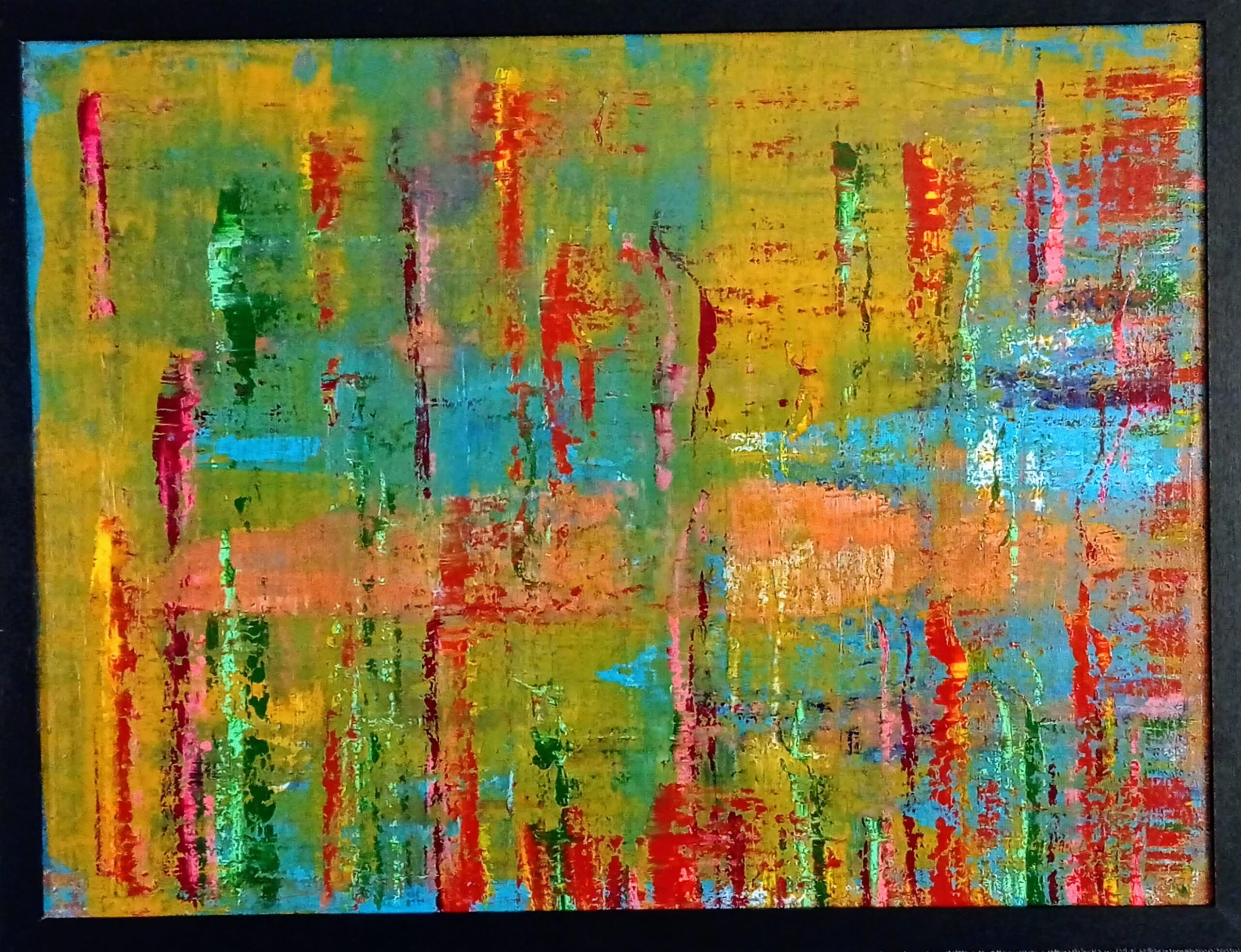
Series:Studies in Raw Material (A pivotal, stand-alone work) Medium: Acrylic on Canvas (framed) Dimensions: 60 cm 80 cm
The “Bywalk Auras” painting is a critical work in the artist’s practice, functioning as a pure visual document of the process of gathering Raw Material. Moving away from the systemic critique of the Clyde series, this canvas focuses entirely on the instantaneous, sensory transfer of energy and atmosphere (the “aura”) experienced during a brief walk.
Sensory Architecture
The palette is intentionally high-energy, dominated by intense yellows, oranges, and sharp vertical strokes of pink and deep red. This is the Visual Code for immediate, unfiltered emotional and sensory input—the “noise” of the environment before the Managed Process has been applied to categorize it.
The technique is defined by strong, vertical energy. The deliberate layering and scraping here emphasize the rapid, intuitive nature of the experience. Unlike the Clyde series, which imposes an intellectual grid to solve a conflict, “Bywalk Auras” celebrates the raw, chaotic beauty of the initial encounter. It is a necessary document of the environment’s pure influence on the psyche.
This painting is a testament to the Lived Art philosophy, proving that even the most fleeting emotional state is considered vital Raw Material—a building block for the larger, more complex Existential Blueprints that follow soon…